

On this page
A sales director leads your sales function, owns the agreed sales target and forecast, and develops the team and process needed to win profitable business. Your sales director job description should define those responsibilities and the authority you will hand over, especially while you still lead customer relationships and close deals.
The template below separates the director’s remit from the preparation your business needs before they arrive. Replace the bracketed fields and remove responsibilities that belong elsewhere.
What should a sales director job description include?
Use this section as your copy-and-edit template, with targets tied to your business plan and current sales capacity.
Role details
Job title: Sales Director.
Reports to: [Founder / Managing Director / Chief Executive].
Responsible for: [Sales team, managers, territories and customer segments].
Location and travel: [Working arrangements and travel requirements].
Remuneration: [Base salary range, variable pay arrangements and benefits].
Scope: [Company-wide / regional / product division], with responsibility for [new business / account growth / renewals, where applicable].
State separately whether the role includes appointment as a statutory company director.
Purpose of the role
Lead the sales function to deliver the agreed revenue and gross profit targets within the company’s commercial plan.
Build a sales operation that can perform without the founder directing everyday opportunities, while maintaining customer relationships and appropriate standards of selling.
Translate the business plan into a sales strategy, an achievable team plan and a forecast that supports decisions about spending and capacity.
Responsibilities
- Set the sales strategy for agreed customer segments, products and territories, including where the team will focus its effort.
- Lead and coach the sales team, with responsibility for recruitment, performance management and development within the approved budget.
- Own the sales process from accepted opportunity to signed agreement and an agreed handover to delivery.
- Maintain an evidence-based forecast, run pipeline reviews and explain changes in expected revenue or timing.
- Manage pricing and negotiation within agreed limits, protecting gross profit and escalating exceptions before commitments are made.
- Agree lead acceptance and follow-up responsibilities with marketing, and coordinate customer commitments with finance and delivery.
Specify whether the director will personally manage strategic accounts or carry an individual sales target, including how that work will fit alongside leadership duties.
Targets and measures they own
Own the sales team’s agreed [quarterly / annual] bookings or revenue target, using the definition agreed with finance.
Own the gross profit or margin target attached to those sales where the role controls pricing and deal structure.
Report on forecast accuracy by comparing the forecast submitted at an agreed point with the eventual result, including whether deals closed when expected.
Monitor conversion between defined sales stages, time spent in each stage and the proportion of opportunities with a current next step.
Include renewal or account expansion targets only where the director controls the people and activity responsible for them.
Agree the starting baseline, reporting frequency and dependencies before confirming targets, including marketing-sourced demand and delivery capacity.
Decision-making authority
The director may approve [discounts and commercial terms] within [documented limits] and allocate the agreed sales budget within [approval rules].
Recruitment, changes to commission arrangements and commitments outside standard contract terms require approval from [named role].
The founder retains responsibility for [reserved decisions and named relationships], with an agreed transfer plan where ownership will change.
First 90 days
Days 1 to 30: Review the team, customer base and live pipeline, and observe how opportunities move from enquiry to signed agreement. Agree the starting forecast and record where data or process gaps limit confidence.
Days 31 to 60: Put the agreed management rhythm in place, including coaching and pipeline reviews. Confirm account ownership, qualification standards and the actions required to move or close each live opportunity.
Days 61 to 90: Present the sales plan for the next planning period, with capacity assumptions, spending requirements and risks. Take ownership of the agreed forecast and document progress against the starting position.
Match expectations for closed business to the existing pipeline and normal buying cycle, including which opportunities pre-date the appointment.
Person specification
Ask candidates to demonstrate:
- Responsibility for a sales target and forecast in a business with a comparable buying process, supported by an explanation of their own contribution.
- Experience leading and developing salespeople, including how they handled underperformance and assessed improvement.
- Commercial judgement across pricing, negotiation and margin, with examples of decisions they were authorised to make.
- Experience taking over customer relationships or sales responsibilities from an owner or senior leader.
Specify sector knowledge where it affects the ability to sell, such as regulated procurement or technical product requirements.
Treat a degree, a familiar employer name or experience with a particular CRM as a preference unless the work requires it.
Evidence to assess during recruitment
Ask candidates to explain how they built a forecast, what caused it to change and how they communicated uncertainty.
Use an anonymised pipeline exercise to assess qualification and judgement, without asking candidates to disclose a previous employer’s confidential information.
Check references against the responsibilities they claim to have owned, including team leadership and the extent of their pricing authority.
Do you need a sales manager, head of sales or sales director?
Titles vary between businesses, so compare the decisions and outcomes attached to the role before choosing a title.
| Role | Typical remit | Authority to define | Founder involvement |
|---|---|---|---|
| Sales manager | Runs day-to-day team activity, coaches sellers and delivers a team target | Opportunity allocation, coaching and execution within an agreed plan | Founder or senior commercial leader usually retains sales strategy and major commercial decisions |
| Head of sales | Leads the sales function and turns business priorities into a sales plan | Team structure, forecasting and sales process, subject to agreed approval limits | Founder agrees direction and budget, with operational sales leadership delegated |
| Sales director | Owns sales strategy and performance within the wider business plan | Sales budget, leadership structure and commercial decisions within explicit limits | Founder retains reserved decisions and holds the director accountable for agreed outcomes |
In a smaller business, a director may still negotiate major deals and coach individual sellers, while a larger organisation may have sales managers reporting into the role.
Your sales director job description should reflect that workload, including whether the appointment covers the whole company or a defined region.
If the work is primarily frontline team management, the guide to UK sales manager salary and the full cost of the hire can help assess that different role without confusing its scope with a director appointment.
What must you hand over before the director starts?
A capable director can improve an imperfect sales operation, but the hiring brief should make the starting position visible.
You need enough structure to distinguish a leadership problem from missing demand, unreliable records or work that nobody currently owns.
A documented sales process
Record how an enquiry becomes an accepted opportunity, what qualifies it for each stage and what evidence is needed before it enters the forecast.
Include the decisions that currently sit in your head, such as which customers are a poor fit and when a discount needs approval.
The process can be short, provided someone other than you can explain what happens next and who is responsible.
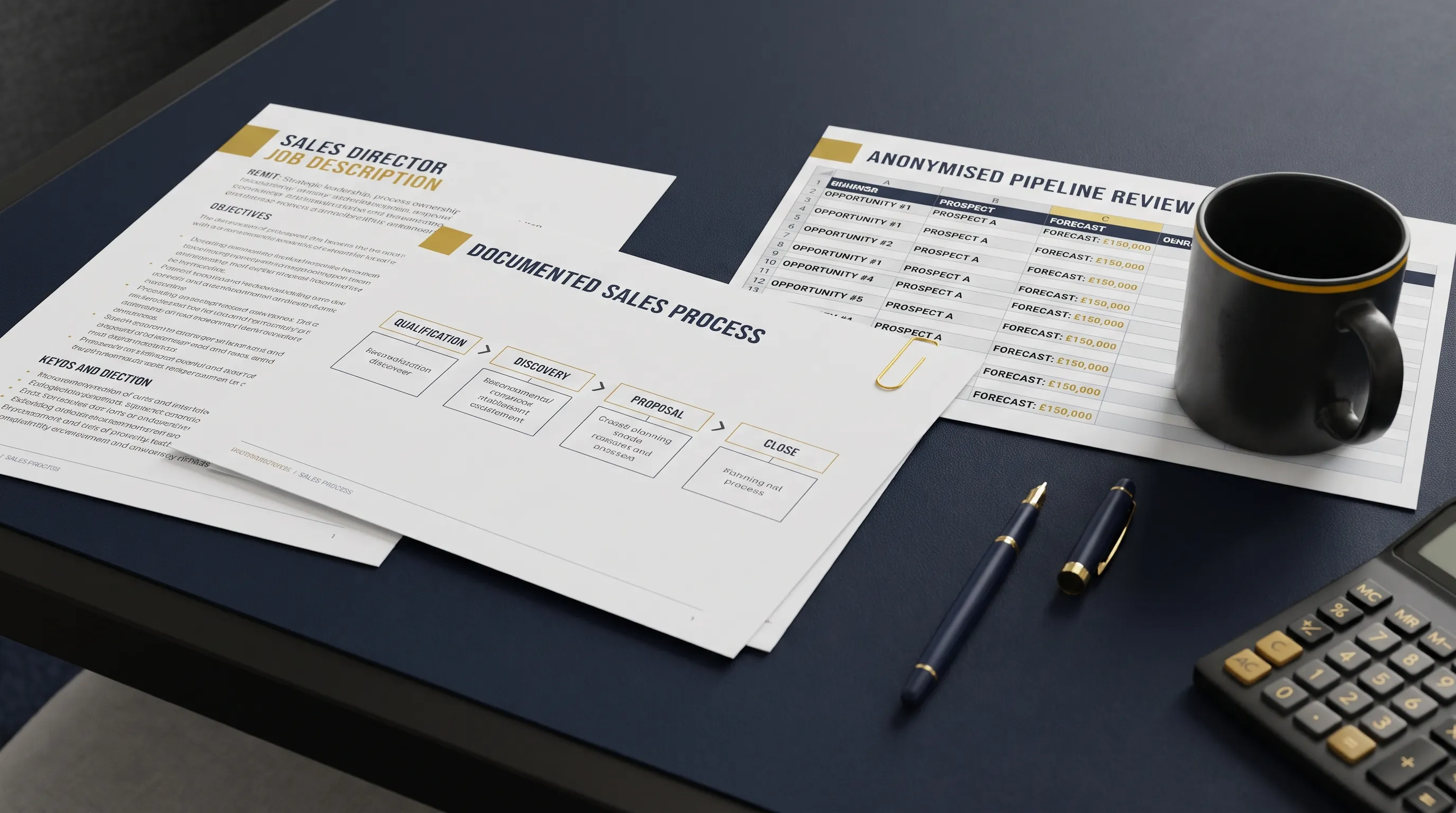
Clean pipeline data
Every live opportunity needs an owner, a realistic value and a next action with a date, alongside evidence for its current stage.
Review expected close dates against the customer’s buying process and remove dead opportunities from the active forecast.
Agree what the numbers represent, since bookings, recognised revenue and cash collected describe different events and should not be used interchangeably.
Keep known uncertainty visible so the new director can assess the pipeline without inheriting unsupported assumptions as commitments.
Lead follow-up that already runs
Assign ownership for new enquiries and define what happens when the usual owner is unavailable.
The existing team needs a working follow-up routine, including how attempts are recorded and when an enquiry is closed or returned to marketing.
The guide to automating sales follow-up without sounding robotic covers that workflow separately from the leadership appointment.
The director can improve the routine after joining, but responsibility for new enquiries should remain assigned throughout recruitment and handover.
Authority and customer relationships
Tell the team which decisions move to the director and which remain with you, including how disagreements will be resolved.
Introduce the director to customers with an explicit explanation of their authority, especially where customers have previously negotiated directly with you.
Keep your involvement in selected accounts deliberate, with named responsibilities that prevent the team receiving conflicting instructions.
A director cannot own the forecast while being excluded from commitments that change it.
Could the gap sit between marketing and sales?
If you need someone to lead sellers, make commercial decisions and own the forecast, a sales leadership hire may be the right answer.
If your immediate difficulty is generating, tracking or following up demand, define that work separately so the appointment does not absorb an unspoken marketing brief.
Where The Growth Install fits
The Growth Install is for founders about to hire a marketing manager, head of marketing or fractional CMO. Over 90 days we install three agreed growth workflows on your own accounts, with tracking and a live dashboard, next to the people who'll own them. It's one flat fee for three months, then it stops. If you still hire, your new hire has something to take over and improve from day one.
That is a different remit from running a sales team, and it does not replace the person accountable for sales leadership.
What else do founders ask before hiring?
Do I need a sales director if I still close most deals?
You may need one if the business requires sales leadership you can no longer provide alongside your other responsibilities. Define which relationships and decisions will transfer, then assess whether the workload calls for a director, a head of sales or a manager.
Should I link commission to revenue or gross profit?
Choose measures the director can influence and align them with the economics of the business. Define how discounts, cancellations and payment terms affect the calculation before agreeing the arrangement.
What's the difference between a sales director and a commercial director?
A sales director usually leads sales strategy and team performance, while a commercial director may also own wider responsibilities such as partnerships or company-wide pricing. Set out the actual authority and reporting lines, because the titles alone do not establish the boundary.
Your options
| Option | Where it fits |
|---|---|
| Hire full time | You need ongoing sales leadership with authority over the team, forecast and agreed commercial decisions. |
| Use an agency | You need a defined service, such as prospecting or appointment setting, with an internal owner accountable for how it connects to sales. |
| Use a fractional director | You need experienced sales leadership on a part-time basis, with enough internal capacity to carry out the agreed work. |
| The Growth Install from Founder Engine (Edinburgh) | Over 90 days Founder Engine installs three agreed growth workflows on your own accounts, with tracking and a live dashboard, next to the people who will own them. One flat fee for three months, then it stops. |