PII Detection: The Stirling-Built Model Keeping Customer Data Out of AI Tools
A small Scottish model can check customer text locally before it reaches an external AI service. Its benchmark result is self-reported, and its licence limits commercial use. See what that means for your business.

PII detection can identify personal data in text before it is sent to an external AI tool, and Vidai’s Stirling-built model lets that check run locally on a CPU. The early release is English only and has a non-commercial licence, so businesses need separate commercial permission and their own testing before using it.
What has Vidai released?
Vidai UK released stirling-minimo-pii-10m on Hugging Face on 30 September 2026 as a v0.1 public preview, according to its model listing.
The company was incorporated in September 2025 and has its registered office in Glasgow, according to Companies House.
Its co-founder, Nagu Gopalakrishnan, says the model was built and trained in Stirling, which explains the name.
His co-founder is Dr Priya Bhagavathy, an Oxford Martin Fellow, according to Vidai’s about page.
Vidai’s model card describes approximately 10 million parameters across six layers, with a tokeniser and architecture built from scratch. It is not a reduced version of another company’s model.
The same card lists a single ONNX file of roughly 43MB and support for 77 types of personal data, in English only.
How good is the model’s reported performance?
Vidai reports an average score of 0.904 on the English tasks of PIIMB, a public benchmark for masking personal data. That score is self-reported, and the submission remains under review, so the model is not yet on the leaderboard.
Against PIIMB’s published results, that score would place third among 36 entries. The leader, an OpenMed model built on OpenAI’s privacy filter, scores 0.918.
The comparison needs more than a headline about model size.
According to the leader’s PIIMB results entry, it has about 1.4 billion parameters in total, making Vidai’s model approximately 140 times smaller by that measure.
But the leader uses a mixture of experts, with about 50 million parameters active for any one word. Comparing active parameters puts the gap at approximately five times.
Those are different measures, and neither should be presented as the whole comparison.
The speed figures are also Vidai’s claims: its model card reports a median of 1.4 milliseconds per text on a standard CPU with eight cores. Those figures have not been independently tested.
Test both accuracy and speed on your own machine before making the model part of a customer workflow.
How does PII detection work?
PII stands for personally identifiable information, an American term. UK law uses personal data, which the Information Commissioner’s Office defines as information relating to an identifiable person.
That includes names and identifying numbers, but it can also include IP addresses and cookie identifiers.
You give the model a piece of text, which it reads in small units called tokens.
It assigns labels such as person or email, then joins adjacent labelled tokens into spans with exact character positions.
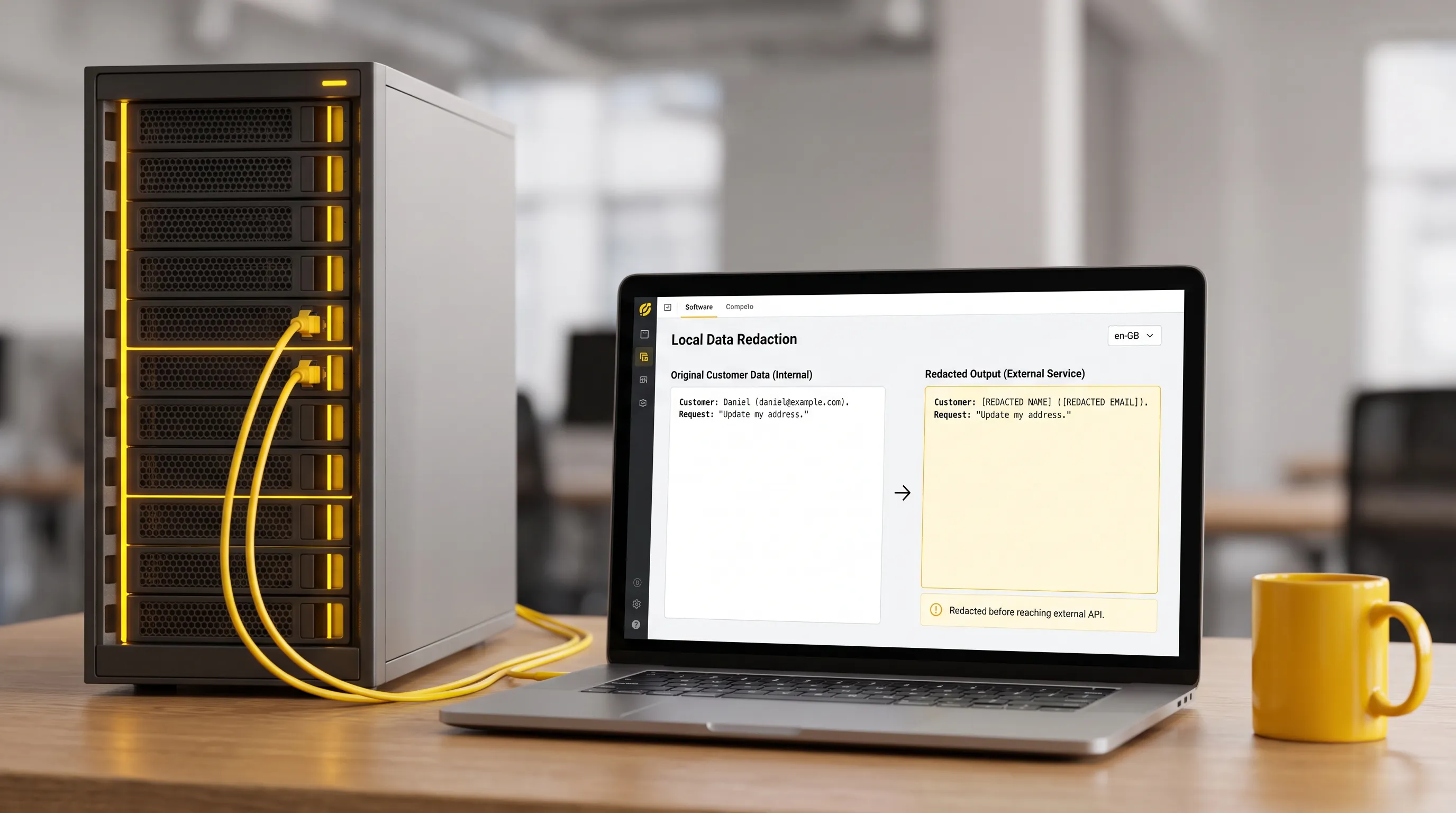
Your software can then replace those spans with placeholders. The model finds the information, while the surrounding software handles redaction.
For example, “Daniel’s email is daniel@example.com” could become “[PERSON]’s email is [EMAIL]” before it leaves your systems.
Pattern matching can recognise an email address from its shape, but names do not follow such a dependable format.
A trained model uses context to recognise that “Marta” in “Marta’s wages” refers to a person.
Vidai says it first trained the model on Wikipedia and the old Enron email archive, followed by public datasets containing personal information and its own synthetic examples.
Why does a small model matter to your business?
A small model can run where your customer data already sits.
Vidai’s model is designed for CPU use, without a graphics card, and can run without an internet connection once installed.
That gives you a way to check text on a laptop or office server before sending anything to an external provider.
A hosted checking service takes a different route: the text goes to another organisation so that organisation can identify the personal data it contains.
Local checking removes that transfer from the detection step. It does not automatically control what your software sends afterwards.
For a support inbox or customer chatbot, the sequence should be explicit: check the text locally, apply the agreed masking rules and inspect what is allowed to leave.
Someone still needs to own that sequence and handle messages the detector misses or flags incorrectly.
What can’t this release do?
Vidai’s model card states that the release reads English only and processes 256 tokens at a time, so longer documents need overlapping chunks.
That creates implementation work for whoever connects it to your systems, including joining results across chunk boundaries.
Some uncommon names, including names with accents, may be split up or missed.
The model also tends to flag too much when text contains little personal data, which can remove information your team needed to keep.
The contextual capability to recognise an indirect health disclosure, such as “she’s off for her scans again”, sits in Vidai’s paid product. It is not included in this release.
The public preview may change before version 1.0, according to the model card.
The licence is CC BY-NC 4.0, so commercial use requires a separate licence from Vidai. Describe the release as open-weight (non-commercial), not open source.
Being able to download the weights does not give your business permission to deploy them commercially.
What else is happening with AI in Scotland?
Vidai is part of a wider Scottish research and business community.
According to the University of Edinburgh, AI research there began in 1963, when Donald Michie started a small group in a flat at 4 Hope Park Square. Michie had worked alongside Alan Turing at Bletchley Park.
The Data Lab has operated since 2014 as Scotland’s innovation centre for data and AI, hosted by the University of Edinburgh with hubs in Glasgow and Aberdeen.
The Scottish Government published its AI strategy for 2026 to 2031 in March, with delivery through AI Scotland.
The strategy includes an expanded adoption programme for SMEs following a first round backed by nearly £1 million, according to the Scottish Government. The Scottish AI Alliance, which delivered the 2021 strategy, has completed its remit.
Scottish Construction Now reports that the UK’s next national supercomputer, backed by up to £750 million, is being built at the University of Edinburgh’s Advanced Computing Facility and is due to start operating in early 2028.
The University of Glasgow also has a Centre for Data Science & AI.
Techscaler, the Scottish Government’s startup programme run by CodeBase, has a Stirling hub and selected Vidai as one of its Ones to Watch this summer.
What should you do with this model?
You probably do not need to download it yourself unless you have a developer and a permitted non-commercial use.
For a commercial deployment, establish the licensing terms with Vidai before building it into your systems.
If your team is connecting a chatbot to a support inbox, a local detector is the kind of safeguard to assess before customer text reaches a model provider.
Give the developer representative examples from your own work through an approved testing process, including unusual names and messages that imply personal information without spelling it out.
Check what gets missed, what gets removed unnecessarily and what happens when a document exceeds the model’s input limit.
For everyone else, start by recording where customer data goes today.
Include your CRM and shared inbox, then check call recording services and chat assistants where staff might paste customer correspondence.
Record which provider receives the text, why it receives it and who is responsible for that transfer.
A detector belongs inside a workflow your team can own and repeat, with a defined response when something fails.
Founder Engine maps customer data flows early in The Growth Install, before a new workflow touches a customer record. The engagement covers three agreed growth workflows on your own accounts, with tracking and a dashboard.
What should you ask before adopting it?
What’s the difference between finding personal data and redacting it?
Detection identifies the parts of a message that contain personal information. Redaction removes or replaces those parts, so you need software that applies the detector’s output before text is sent elsewhere.
Can my business use stirling-minimo-pii-10m commercially?
The CC BY-NC 4.0 licence does not permit commercial use. A commercial deployment requires a separate licence from Vidai, even if you run the model entirely on your own server.
Does PII detection make my business GDPR compliant?
Running this model does not make your business GDPR compliant, and Vidai’s model card leaves compliance responsibility with the organisation holding the data. The ICO states that pseudonymised data remains personal data, so replacing names with placeholders does not automatically take the resulting text outside data protection law.
If you want help working out where growth is getting stuck, talk to Founder Engine.