Before You Hire: Marketing Manager Job Description Template
Give your next marketing manager a remit they can deliver, with agreed authority and measures tied to revenue. Copy a UK employer template covering the first 90 days, CRM records and monthly reporting.

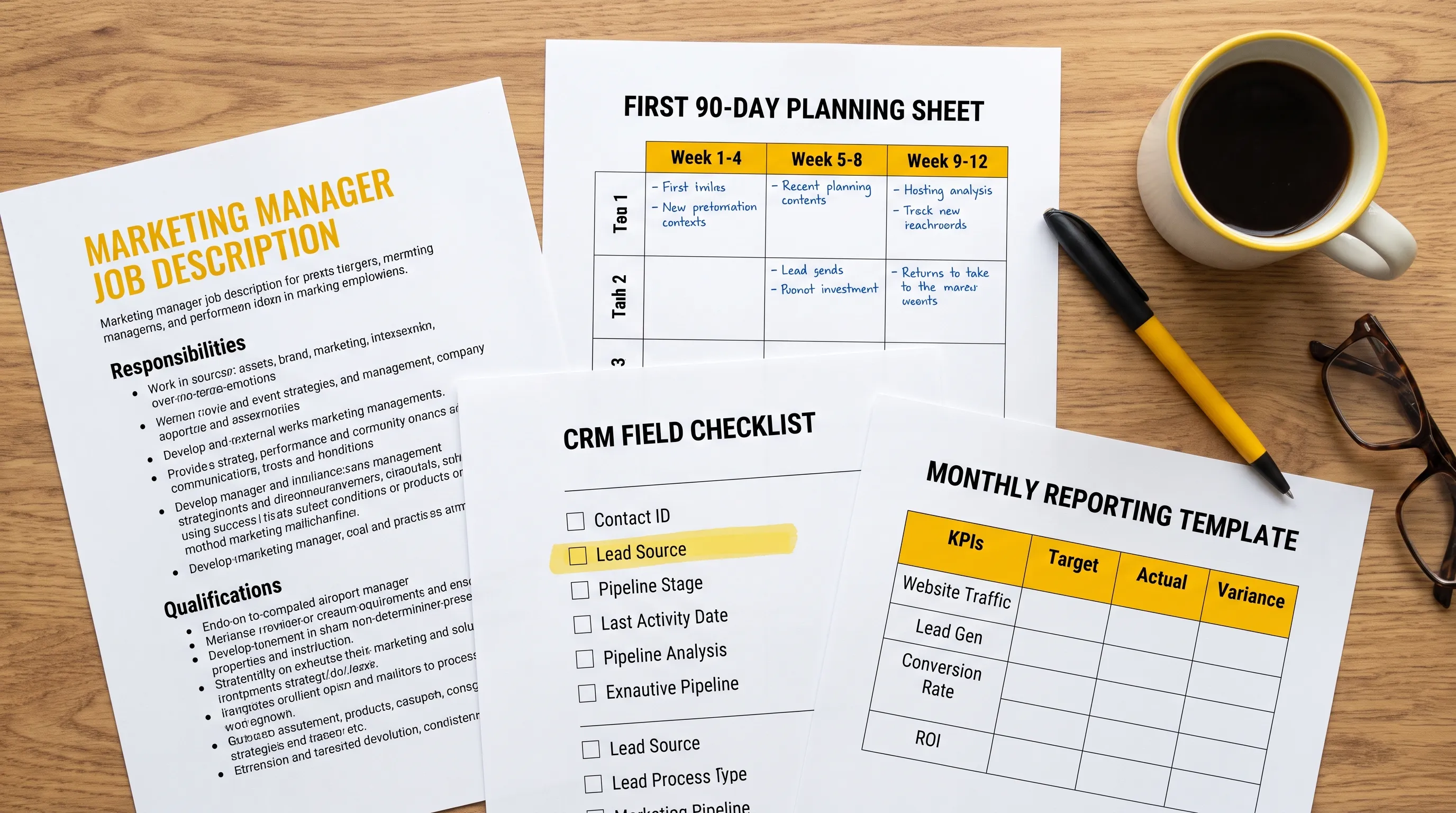
A marketing manager job description should define the outcomes you expect and the authority the person needs to deliver them. Use the employer template below to agree responsibilities and first 90-day priorities, including how the role will maintain CRM records and report marketing's contribution to revenue each month.
What should you decide before advertising the role?
Decide whether you need someone to run an established marketing operation or build the foundations it is missing, because those are different recruitment briefs.
A manager can take responsibility for delivery within an agreed commercial plan, but you must say who sets that plan and who approves changes to it.
Define the recurring workload before choosing the title: which campaigns need managing, what happens to enquiries and how much specialist delivery support is available.
If the remit includes setting company-wide commercial strategy or building a department, assess whether the authority and seniority belong in a director-level role.
The preparation described in what to put in place before you hire a marketing director also helps you separate a management vacancy from work the business needs to organise first.
Agree your sales responsibilities too, so the new hire can improve lead quality without being held solely responsible for deals someone else must close.
What should a marketing manager job description include?
Copy the following employer-side role profile and replace the bracketed fields before sharing it with candidates. Remove any responsibility you cannot support with time, budget or access.
Role details
Job title: Marketing Manager. Reporting line: [founder, managing director or commercial leader].
Business remit: [product, service, market or division], with [direct reports or no people-management responsibility].
Salary range: [range], with [contract type and hours] based at [location and working arrangements].
Delivery support: [internal colleagues, agency support or specialist contractors available to the role].
Purpose and agreed outcomes
You will manage the marketing work that helps suitable customers find the business and progress towards a sales conversation or purchase.
You will translate the agreed commercial priorities into a deliverable marketing plan, with named owners and measures for each priority.
The agreed outcomes are [specific improvement in qualified enquiries or conversion] and [specific improvement in measurement or delivery], assessed against [baseline] at [review dates].
A qualified enquiry means [customer fit and evidence of buying interest], with exclusions recorded so that marketing and sales use the same definition.
Where the baseline is incomplete, you will establish it during the initial review period and agree targets with [approver] before those targets become performance measures.
Revenue and pipeline will be reviewed alongside measures you can directly affect, such as enquiry quality and conversion on the pages you manage.
Responsibilities and boundaries
You will maintain the marketing plan and manage delivery across [named channels or work areas], choosing priorities within the agreed capacity.
You will improve the relevant website pages and enquiry routes, checking that tracking works before campaigns go live.
You will coordinate the handover to sales, maintain the marketing elements of CRM records and investigate gaps in reporting.
You will brief and review specialist work supplied by [agency or contractors], including approval of deliverables within your delegated authority.
You are not expected to provide specialist design, development or paid-media execution unless those responsibilities are explicitly included and resourced.
Sales follow-up is owned by [role], website development by [role or supplier] and final approval of regulated or technical claims by [approver].
Decision rights and support
You can make the following decisions within the approved plan, subject to the business's procurement and approval rules.
| Decision | Delegated authority | Approval or escalation |
|---|---|---|
| Campaign priorities | Schedule work within the agreed commercial priorities | Escalate changes affecting sales commitments or other teams |
| Marketing spend | Allocate spend within [budget] and [spending limit] | Seek approval for additional spend or commitments beyond that limit |
| Website and campaign content | Approve routine changes within agreed brand and claims guidance | Refer technical, legal or regulated claims to [approver] |
| Suppliers | Brief and manage approved suppliers | Obtain approval before appointing suppliers or changing contracts |
| Measurement | Maintain agreed definitions and reporting processes | Agree attribution changes with the commercial and finance owners |
The business will provide access to the company-owned accounts required for the role, using appropriate permissions and individual logins.
You will have access to [sales owner] for lead-quality reviews and [finance owner] for reconciling commercial results.
Where delivery is blocked by missing access or another team's decision, record the dependency and escalate it to [role].
First 90 days
Days 1 to 30: Review the agreed commercial plan and current marketing work, then check how enquiries are captured and handed over. Produce a baseline covering available enquiry, opportunity and conversion data, with missing information recorded explicitly.
Agree the initial priorities with your manager and confirm the support required to deliver them.
Days 31 to 60: Implement the approved priority changes and check that each has a named owner and working measurement. Resolve agreed tracking gaps and test the sales handover with the people responsible for follow-up.
Deliver the first monthly report using the definitions agreed with sales and finance.
Days 61 to 90: Review the early results against the baseline and explain which changes should continue, stop or be adjusted. Document recurring work so that the process can continue during absence or supplier changes.
Agree the next delivery plan and performance measures, allowing for the business's sales cycle and the amount of evidence available.
Attribution rules
You will maintain an agreed attribution policy that records where enquiries originated and distinguishes that information from later marketing contact.
The policy must define what counts as marketing-sourced business and what counts as marketing-influenced business, including how referrals and existing customers are handled.
Record a customer's stated source separately from tracked campaign data, because the two may describe different parts of the buying process.
Keep unknown sources visible and document conflicting evidence instead of assigning an unsupported channel.
Count each opportunity once in marketing-sourced totals and report influenced opportunities separately, without adding the categories together.
Explain the limits of the available tracking in the monthly report, including gaps caused by offline activity or missing records.
CRM fields and ownership
Maintain these fields across linked enquiry and opportunity records, adapting the field names to the existing CRM.
| Field group | Information to record | Maintenance owner |
|---|---|---|
| Record identity | Enquiry or contact ID linked to the relevant opportunity ID | Agreed CRM owner |
| Enquiry timing | Enquiry received date and time | Capture process, checked by marketing |
| Source evidence | Original source, campaign details where available and customer's stated source | Marketing, with input from sales |
| Qualification | Fit criteria, qualification status and rejection reason | Agreed qualification owner |
| Handover | Assigned sales owner and first follow-up date and time | Sales |
| Opportunity progress | Current stage and dates of stage changes | Sales |
| Commercial value | Deal value on the agreed basis and expected close date | Sales, with finance definitions |
| Outcome | Won or lost status, actual close date and loss reason | Sales |
Use agreed field definitions and distinguish missing information from confirmed negative answers.
Marketing owns the reporting process, but sales remains responsible for updating the records it uses to manage opportunities.
Follow the business's rules for personal data, account access and retention, collecting only information needed for the agreed purpose.
Monthly reporting
Produce a monthly report for [review owner] showing marketing spend alongside qualified enquiries and progression into opportunities.
Separate new enquiries from existing pipeline, and separate the value of won deals from revenue recorded by finance.
Use the same definitions each month and explain changes to attribution or reporting periods before comparing results.
Include a short account of work completed, what the evidence supports and the next decision required from the business.
Where a channel produces enquiries that sales rejects, report the rejection reasons alongside volume so the team can decide what to change.
Keep traffic, rankings and engagement as supporting measures when they help explain commercial performance.
Required capability
You can plan and deliver marketing work within a budget, interpret commercial data and coordinate colleagues or suppliers whose work affects delivery.
You can explain how you would check attribution, maintain CRM reporting and turn a performance review into a decision about the next work to do.
Required sector or channel experience: [requirements linked to the actual remit]. Experience that would help but is not required: [additional criteria].
How should you assess candidates against the brief?
Use the marketing manager job description as the basis for assessment, so candidates are judged against the work you need done.
Ask for examples that establish their own contribution and the authority they held, including how they worked with sales when marketing results did not translate into opportunities.
Give candidates an anonymised enquiry report and ask which missing information would prevent a commercial decision, keeping any assessment proportionate to the role.
Someone who recognises an attribution gap may be better suited to your brief than someone who presents confident conclusions from incomplete records.
Keep requirements tied to the work and follow the UK guidance on discrimination in recruitment when preparing the advert and selection process.
What should you check before publishing the vacancy?
Use this employer checklist to confirm that the role can function inside your business.
- The reporting line and business remit are named.
- The outcomes have a baseline, or establishing one is an explicit initial responsibility.
- The manager has spending and approval limits that match the expected responsibility.
- Required accounts are company-owned, with a route to grant appropriate access.
- Sales has accepted responsibility for follow-up and opportunity updates.
- Specialist work has an owner and an available budget.
- The monthly report has an agreed audience and definitions.
- The first 90-day plan allows for dependencies and the length of the sales cycle.
If several items remain undecided, resolve them with the people who will work alongside the new hire before advertising.
For decisions about who should own the supporting work, use how to build an in-house marketing team around real work to map responsibilities without loading every discipline into one vacancy.
Should you hire now or put the work in place first?
A hire makes sense when you have continuing work for an employee and authority ready to delegate, while an agency can suit a defined specialist requirement with an internal owner.
If the proposed role would begin by establishing measurement and repairing handovers, you can put that work in place before committing to permanent headcount.
Founder Engine offers The Growth Install as an alternative to adding a marketing hire for this defined scope.
It runs for 90 days and installs three agreed growth workflows, each in one agreed area, on your own accounts, with tracking and a dashboard.
Founder Engine works alongside the people who will own those workflows, and your business owns its accounts and systems. The engagement does not cover every channel or replace a marketing department.
What else should you decide before hiring?
Do I need a marketing manager or a marketing director?
A manager role fits a business that needs someone to organise and deliver marketing within an agreed commercial direction. A director role fits a wider remit involving strategy and authority over departmental resources. Match the title to the decisions the person will own and the support available to them.
Should I make the marketing manager responsible for revenue?
Include revenue in the commercial review, with shared responsibilities stated explicitly. A manager can own agreed marketing inputs and improvements, but sales follow-up and closing decisions may sit elsewhere. Set individual performance measures around work they can control or influence with agreed support.
Do I need clean CRM data before hiring?
You need enough information to describe the current position and identify gaps. Complete records are not a condition for every hire, but repairing them must have an owner and allocated time. Tell candidates whether measurement already works or is part of their initial remit.
Can a marketing manager manage an agency as well?
Yes, if supplier management is included in the workload and the manager has authority to approve work within the agreed budget. Specify what the agency delivers and which responsibilities remain internal. Allow time for briefing and review when assessing the role's capacity.
If you want help working out where growth is getting stuck, talk to Founder Engine.